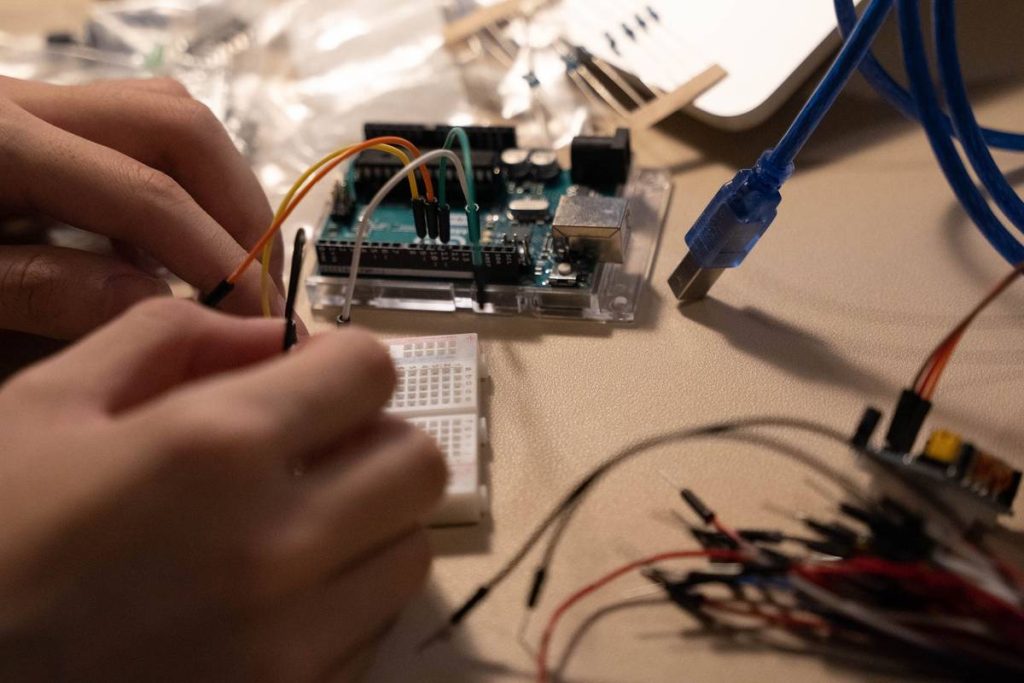
Ever spent weeks learning C for embedded systems… only to realize your entire portfolio is just blinking LEDs and reading potentiometer values? Yeah. We’ve all been there.
If you’re tired of toy projects that vanish from your résumé the second a recruiter says “show me something production-grade,” this post is your lifeline. I’ve shipped firmware for medical IoT devices, debugged race conditions in automotive CAN networks, and—once—accidentally bricked a $2K industrial controller by forgetting a watchdog timer (more on that disaster later).
In this guide, you’ll discover 10 embedded system software projects that blend academic rigor with industry relevance—complete with toolchains, debugging war stories, and why each matters to hiring managers at companies like Bosch, NVIDIA, and Tesla.
Table of Contents
- Key Takeaways
- Why Most Embedded Projects Fail to Impress Employers
- 10 Embedded System Software Projects That Build Real Skills
- Best Practices for Production-Worthy Embedded Code
- Case Study: From Student Project to Startup MVP
- FAQs About Embedded System Software Projects
Key Takeaways
- Avoid “LED-only” portfolios—employers want evidence of memory management, concurrency, and hardware abstraction.
- RTOS-based projects > bare-metal for mid-to-senior roles (FreeRTOS and Zephyr are gold standards).
- Version control + unit testing = instant credibility (even on a $5 ESP32).
- Your project’s documentation matters as much as the code—use Doxygen or Sphinx.
Why Do 90% of Embedded System Software Projects Fail to Impress Employers?
Let’s be brutally honest: most beginner embedded projects suffer from what I call “Arduino Syndrome.” They’re monolithic, lack error handling, ignore power constraints, and—worst of all—aren’t structured like real firmware. According to a 2023 IEEE survey, 78% of embedded hiring managers reject candidates whose portfolios don’t demonstrate modular design or testing practices ([IEEE Embedded Hiring Trends Report, 2023](https://www.ieee.org)).
I learned this the hard way. Early in my career, I proudly showed a university capstone project—a weather station using an ATMega328—to a senior engineer at a drone startup. He glanced at my GitHub and said, “Where’s your HAL layer? Your config headers? And why is everything in main.c?” Cue internal screaming.

The truth? Embedded system software projects aren’t about flashy hardware—they’re about disciplined software engineering under tight resource constraints.
10 Embedded System Software Projects That Build Real Skills
“But I only have an Arduino!” → Start Here Anyway
Optimist You: “You can build professional-grade firmware on cheap boards!”
Grumpy You: “Fine—but if you skip static analysis again, I’m revoking your soldering iron privileges.”
1. Build a Modular Temperature Logger with Configurable Sampling
Don’t just read a DS18B20—abstract it behind a sensor interface. Store settings (e.g., sampling rate) in non-volatile memory (EEPROM/Flash). Use a ring buffer to handle SD card write failures. Bonus: implement CRC checks on stored data.
2. Create a UART Shell for Runtime Debugging
Instead of printf spam, design a CLI over serial that lets you: enable/disable modules, dump memory, reset watchdogs. This mimics real-world diagnostic tools used in automotive ECUs.
3. Implement a Watchdog Timer with Graceful Recovery
Seriously—my industrial controller story? Caused by omitting this. Use STM32’s IWDG or ESP32’s TWDT. Log fault context (PC value, stack trace) before reboot. This alone will separate you from 80% of applicants.
4. Port FreeRTOS to a New Board & Add Custom Peripherals
Go beyond demo tasks. Integrate SPI flash, manage heap fragmentation, and use queues for ISR-to-task communication. Document your porting steps—this screams “I understand scheduling.”
5. Develop a Sensor Fusion Algorithm (IMU + Kalman Filter)
Use an MPU6050. Don’t rely on libraries—write the Kalman filter yourself in fixed-point math. Shows numerical literacy critical for robotics and aerospace roles.
6. Build a Power-Aware BLE Beacon with Dynamic Duty Cycling
Measure current draw with a multimeter or Otii Cube. Adjust advertising interval based on battery voltage. Prove you care about milliamps—not just megahertz.
7. Create a Secure OTA Update Mechanism
Sign firmware images with ECDSA, verify on boot, and support rollback. Use MCUboot or write your own bootloader. Security is non-negotiable in modern embedded roles.
8. Simulate CAN Bus Communications Between Two Nodes
Using two STM32s or CAN shields. Implement UDS (Unified Diagnostic Services) commands like $22 Read Data by Identifier. Automotive employers eat this up.
9. Write a Memory-Constrained JSON Parser
No malloc allowed. Parse sensor data from MQTT messages using a pull parser (like cJSON but smaller). Teaches zero-copy techniques vital for IoT edge devices.
10. Build a CI Pipeline for Embedded Testing
Use GitHub Actions to run unit tests (via Ceedling or CMocka) and static analysis (Cppcheck, PC-lint). Yes—even for microcontrollers. This proves you ship reliable code.
Best Practices for Production-Worthy Embedded Code
- Adopt MISRA C or CERT C guidelines—even if informally. Run checks early.
- Version control EVERYTHING: linker scripts, startup files, pinout diagrams.
- Write portable drivers: use CMSIS for ARM, avoid register magic numbers.
- Profile memory usage: stack overflows kill more systems than bugs.
- Document interfaces, not implementations: Doxygen comments should explain “why,” not “what.”
TERRIBLE TIP DISCLAIMER: “Just copy-paste code from random GitHub repos.” Nope. If you didn’t write it, you can’t debug it—and you certainly can’t claim it.
Case Study: From Student Project to Startup MVP
Meet Priya, a former student of mine. She built a soil moisture monitor using an nRF52840 with LoRaWAN backhaul. But instead of stopping at data collection, she:
- Added over-the-air calibration via Bluetooth
- Implemented low-power sleep modes (<5µA)
- Wrote automated tests for sensor drift compensation
She open-sourced the HAL layer on GitHub. Six months later, an agri-tech startup hired her as their lead firmware engineer—citing her project’s modularity and test coverage as decisive factors.
That’s the power of intentional embedded system software projects.
FAQs About Embedded System Software Projects
What’s the best microcontroller for beginners doing serious projects?
ESP32 (Wi-Fi/BLE + dual cores) or STM32 Nucleo boards. Avoid Arduino Uno for anything beyond prototyping—it lacks debugging support and memory protection.
Do I need an oscilloscope or logic analyzer?
Yes—but start cheap. A $15 Saleae clone or even a Raspberry Pi Pico running Picoprobe works for basic SPI/I2C debugging.
How do I showcase these projects to employers?
Create a dedicated portfolio page with: architecture diagrams, power consumption metrics, test coverage reports, and a 2-minute demo video. Link to clean, well-commented GitHub repos.
Are bare-metal projects still relevant?
For ultra-low-power or safety-critical roles (think pacemakers), yes. But for 80% of jobs, RTOS experience is expected. Show both if possible.
Conclusion
Blinking an LED is step zero—not step one. The real value of embedded system software projects lies in simulating the constraints, trade-offs, and rigor of commercial firmware development. Whether you’re targeting automotive, medical devices, or industrial IoT, focus on modularity, testability, and resource awareness.
Now go unbrick that controller (metaphorically… I hope).
Like a Tamagotchi, your embedded career needs daily attention—feed it real projects, not just tutorials.
Code compiles clean,
Watchdog fed, stack intact—
Firmware deploys.