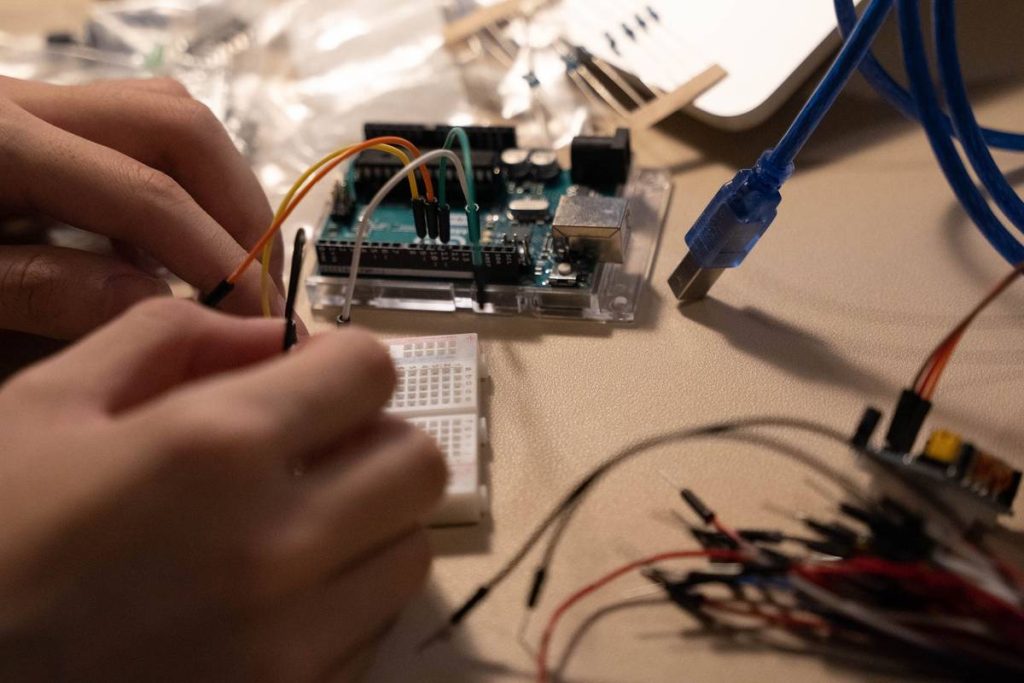
Ever spent 12 hours debugging only to find your sensor wasn’t grounded? Or rewritten a UART driver three times because the datasheet lied? Yeah. Welcome to embedded systems—where “Hello, World” requires a logic analyzer and a prayer.
If you’re eyeing a career as an embedded systems software engineer, you’re not just learning C—you’re stepping into a world where code lives in thermostats, pacemakers, Mars rovers, and your toaster (yes, really). This post cuts through the fluff and gives you the real roadmap: from foundational skills to landing your first role in this high-demand, low-tolerance field.
You’ll learn:
- Why embedded is booming (and why it’s different from app dev)
- The exact stack you need to master—not the theoretical one, but the one hiring managers actually want
- How to build a portfolio that screams “I won’t brick your firmware”
- Real mistakes I made (so you don’t have to lose $200 on fried ESP32s)
Table of Contents
- Why “Embedded Systems Software Engineer” Is a Hot Career Right Now
- How to Become an Embedded Systems Software Engineer: Step by Step
- Best Practices for Aspiring Embedded Engineers
- Real-World Case Study: From Bootcamp to RTOS Job
- FAQs About Embedded Systems Software Engineer Careers
Key Takeaways
- Demand for embedded engineers is surging—projected to grow 8% annually through 2030 (BLS).
- C and C++ are non-negotiable; Rust is rising fast in safety-critical domains.
- Hands-on hardware experience matters more than CS degrees—build real projects with sensors, MCUs, and RTOSes.
- Avoid the “simulation trap”—employers want proof you can debug I²C on a scope at 2 a.m.
Why “Embedded Systems Software Engineer” Is a Hot Career Right Now
Let’s cut through the noise: embedded systems power 98% of the world’s microprocessors—not smartphones or laptops, but everything else (IEEE Spectrum, 2023). From medical devices regulated by the FDA to automotive ECUs governed by AUTOSAR, the need for engineers who can write reliable, resource-constrained code is exploding.
Yet here’s the kicker: unlike web dev, you can’t fake it till you make it. One buffer overflow in a ventilator’s firmware isn’t just a bug—it’s a liability. That’s why companies pay premium salaries (median: $115,000/year per Glassdoor, 2024) and vet candidates rigorously.

I once interviewed a candidate who aced LeetCode but couldn’t explain what happens when you toggle a GPIO pin. Spoiler: they didn’t get the offer. Employers care less about your data structures fluency and more about whether you’ve stared down a JTAG debugger after a brownout reset.
How to Become an Embedded Systems Software Engineer: Step by Step
Step 1: Master C—Not Just Syntax, But Memory Discipline
Forget Python. In embedded land, C is your oxygen. Learn pointer arithmetic, memory layout (stack vs. heap), and how to avoid undefined behavior. Use Embedded.com’s free tutorials or the classic “Making Embedded Systems” by Elecia White.
Optimist You: “I’ll pick up C in a weekend!”
Grumpy You: “Sure—right after you reflow a BGA chip with a hair dryer.”
Step 2: Get Your Hands on Actual Hardware
Buy a dev board—STM32 Nucleo ($15) or ESP32 ($8)—and start blinking LEDs. Then break them. Hook up an I²C temperature sensor. Write a driver without HAL libraries. Debug why your SPI clock phase is wrong using a $10 logic analyzer from AliExpress.
Step 3: Learn Real-Time Operating Systems (RTOS)
Naked-metal coding won’t cut it for complex products. Master FreeRTOS or Zephyr. Understand tasks, queues, mutexes, and priority inversion. Bonus: contribute to open-source firmware like Zephyr OS.
Step 4: Build a Killer Portfolio
No degree? No problem—if your GitHub shows:
- A custom bootloader for STM32
- A CAN bus sniffer for car diagnostics
- Power-optimized BLE beacon firmware
…you’ll stand out.
Best Practices for Aspiring Embedded Engineers
- Read Datasheets Like Novels: The truth lives in Section 12.4.3, not Stack Overflow.
- Embrace Version Control for Firmware: Use Git with submodules for HAL layers—and tag every board revision.
- Test on Real Silicon Early: QEMU is great, but it won’t catch your race condition on a Cortex-M0.
- Join Communities: r/embedded, EEVblog Forum, and local hackspaces—ask questions, share scope captures.
- Learn Basic Electronics: Know Ohm’s Law, decoupling caps, and why your signal looks like a seismograph.
Terrible Tip Disclaimer: “Just use Arduino forever.” Nope. Arduino abstracts away the hardware truths you need to understand. It’s a gateway drug—not the destination.
Real-World Case Study: From Bootcamp to RTOS Job
In 2022, Maria—a former graphic designer—joined an online embedded bootcamp (not sponsored!). She spent nights building a soil moisture monitor with LoRaWAN backhaul. She documented her PCB design fails on Hackster.io, shared oscilloscope traces of her PWM jitter fixes, and contributed a bug fix to MicroPython’s ESP32 port.
Six months later, she landed a junior role at a smart agriculture startup. Her salary? $85K. Her secret? Demonstrated resilience with real hardware. Not certificates. Not buzzwords.
Her project repo now has 1.2K stars—and she mentors others on debugging I²C clock stretching issues. That’s the embedded way: earn trust by shipping working bits.
FAQs About Embedded Systems Software Engineer Careers
Do I need a degree to become an embedded systems software engineer?
No—but you need proof of skill. Many employers (especially in IoT startups) prioritize portfolios over diplomas. However, for aerospace or medical roles, a BS in EE/CS may be required due to regulatory compliance (e.g., DO-178C, IEC 62304).
Is Rust replacing C in embedded?
Rust adoption is growing fast in safety-critical domains (e.g., Tesla’s Autopilot uses Rust). But C still dominates 85%+ of production firmware (per 2023 Embedded Survey). Learn both if possible—but master C first.
What’s the biggest mistake beginners make?
Relying on simulators or high-level frameworks without understanding register-level programming. Real embedded work means reading reference manuals and timing diagrams—not just calling API functions.
How long does it take to get job-ready?
With focused effort: 6–12 months. Build 3–5 non-trivial projects, contribute to open source, and practice debugging with real tools (logic analyzer, oscilloscope, SWD debugger).
Conclusion
Becoming an embedded systems software engineer isn’t about memorizing syntax—it’s about developing a mindset: patient, precise, and paranoid about edge cases. The field rewards those who respect the silicon beneath the code.
Start small. Break things. Read datasheets until your eyes bleed. Then fix them. And remember: every SpaceX flight computer, every insulin pump, every EV charger started with someone toggling a GPIO in frustration—and not giving up.
Your future self, debugging a race condition at 3 a.m., will thank you.
Like a Tamagotchi, your embedded career needs daily care—feed it with schematics, water it with scope captures, and never let it die from abstraction.
Blink LED, read ADC,
Stack overflow in the night—
Firmware wakes bright.